Imagine this: You shut your laptop at 6:00 PM. You have dinner, relax, and get a full eight hours of sleep. When you wake up the next morning and open your inbox, the marketing graphics you requested are designed and ready for review. Your inbox has been sorted, the spam deleted, and priority client emails flagged. A fresh batch of outbound leads has been qualified and loaded into your CRM.
You haven’t even had your morning coffee yet, and your business has already moved forward.
This isn’t a fantasy reserved for Fortune 500 CEOs. It’s the reality of asynchronous remote work.
For modern, scaling brands, the traditional 9-to-5 workday is rapidly becoming obsolete. When you restrict your business operations to the hours you’re personally awake and sitting at a desk, you inherently cap your growth. But when you embrace asynchronous communication and build a distributed creative team, you unlock the ability to run a 24/7 operation.
Here is why scaling businesses are ditching synchronous, meeting-heavy cultures and how asynchronous work, often powered by a dedicated virtual assistant agency, is the ultimate growth hack for the modern entrepreneur.
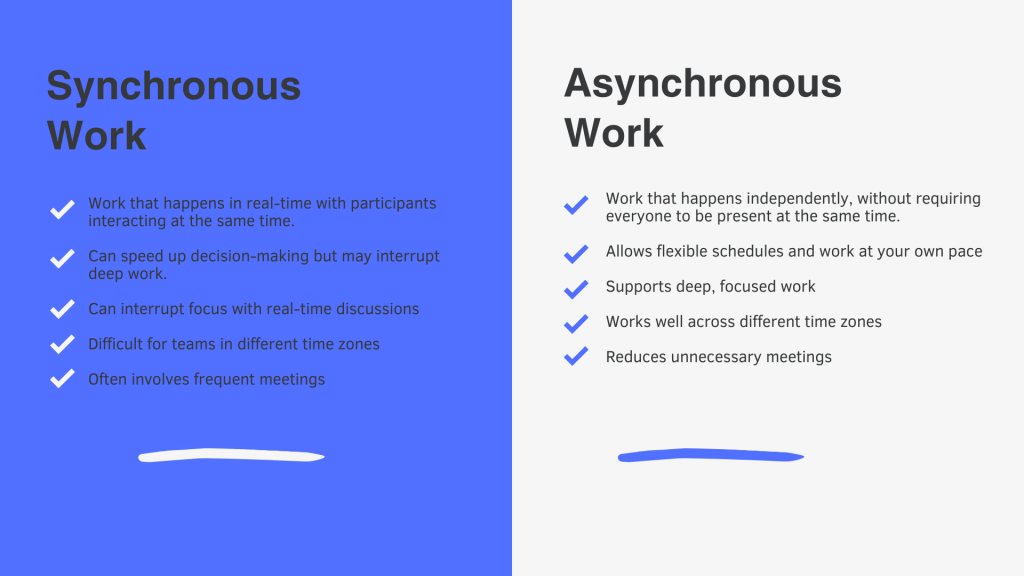
Before diving into the benefits, we need to clarify what asynchronous (often called “async”) work actually means.
Synchronous work happens in real-time. It requires all parties to be present at the same time. Think Zoom meetings, instant Slack messaging where immediate replies are expected, or tapping a colleague on the shoulder in a physical office. While sometimes necessary for complex brainstorming or immediate crisis management, synchronous work is incredibly disruptive. It demands your immediate attention and shatters deep concentration.
Asynchronous work, on the other hand, happens on the individual’s schedule. Information is communicated and documented, and the recipient responds or takes action when it suits their workflow. Think detailed project briefs in Asana or Trello, recorded Loom videos explaining a new standard operating procedure (SOP), or comprehensive email updates.
Async work is built on a foundation of trust and thorough documentation. It shifts the metric of success from “hours spent sitting at a desk looking active” to “actual results delivered.”
Turning Time Zones into Your Superpower
One of the greatest misconceptions about remote work is that everyone still needs to overlap their hours. Many companies try to force their global workforce to align with a central headquarters’ time zone. This is a massive missed opportunity.
When you strategically embrace a distributed team, time zones stop being a hurdle and start becoming your biggest asset. This is often referred to as “geo-arbitrage” or building a “follow-the-sun” model.
Consider a highly effective agency structure: You might have your visionary leadership and client-facing Account Managers based in North America or the UK. Meanwhile, your powerhouse execution team: the creative strategists, virtual assistants, and digital marketers—is based in a dynamic hub across the world, such as the Philippines, India, and other African countries.
This is not an accident; it is a calculated operational strategy.
When the team in Texas or London logs off for the day, they hand over their strategic briefs, marketing outlines, and administrative tasks, and while they sleep, the other team is logging on for their normal workday. They spend their daylight hours executing those tasks with deep focus, free from the constant pinging of the leadership team, and by the time the main headquarters wakes up, the deliverables are sitting in their inbox.
Transitioning to an asynchronous model requires a fundamental shift in how you view productivity. If you are a founder who measures success by how quickly your team replies to a direct message, async work will feel uncomfortable at first. But the brands that make the leap experience incredible operational benefits.
According to research, it takes an average of 23 minutes to regain deep focus after a distraction. In a synchronous office environment, those distractions happen constantly.
Asynchronous work protects your team’s time. A virtual assistant managing your social media calendar or a designer creating ad creatives can block out four hours of uninterrupted “deep work” without being pulled into an impromptu meeting. This leads to higher-quality output, fewer errors, and a significantly faster turnaround time on complex projects.
If your business only moves when you are moving, your speed to market is inherently limited. Asynchronous work acts as an operational multiplier.
Imagine you’re launching a new digital product. You outline the email marketing sequence on Monday afternoon. You pass the brief to your virtual assistant agency.
By Tuesday morning, the emails are drafted, formatted, and loaded into your CRM for your final approval. If you had to wait for a synchronous meeting to discuss the emails, assign them, and review them together, that same process could take a week. Async work condenses timelines dramatically.
When you let go of the requirement that your team must work between 9 AM and 5 PM in your specific zip code, the entire world opens up to you. You are no longer restricted to the talent available within a 30-mile commute of an office, nor are you forced to pay the inflated overhead costs of major tech hubs.
You can partner with a managed virtual assistant agency that sources top-tier, highly educated, and fluent professionals globally. You get world-class marketing, administrative, and creative support while optimizing your budget.

The idea of asynchronous remote work sounds incredible, but the execution is where many founders stumble. They often rush to freelance marketplaces, hire a solo contractor on the other side of the world, and then become frustrated when tasks are misunderstood or deadlines are missed.
This happens because async work requires robust systems, and solo freelancers rarely come with built-in infrastructure. This is where partnering with a dedicated virtual assistant agency changes the game.
When you work with an agency to build your distributed team, you aren’t just buying hours of labor; you’re buying an established operational framework. A premium agency provides:
Vetted Talent: You bypass the resume-sifting and interview fatigue. You are paired with professionals who already have the hard skills required for digital marketing, inbox management, or creative support.
Built-in Accountability: In an async environment, accountability is everything. An agency typically provides Account Managers or structured reporting systems to ensure that work is progressing, even when you aren’t actively watching.
Continuity and Scalability: If a solo freelancer gets sick or is unavailable, your async workflow grinds to a halt, but with an agency, there’s always a backup plan ready in place. If your primary virtual assistant is out, the agency ensures the gap is covered so you still wake up to progress.
You cannot simply declare your company “asynchronous” and expect immediate results; it requires a deliberate operational design. If you’re preparing to bring on a virtual assistant or expand your remote team, here are the three pillars you must establish first.
In a synchronous office, you can lean over a desk and say, “Hey, can you do it like this instead?” In an async environment, ambiguity is the enemy of progress.
You must build Standard Operating Procedures (SOPs). Every repetitive task in your business, from how you format a blog post to how you respond to a customer service inquiry, should be documented. The most effective way to do this is through screen-recording tools like Loom. Record yourself doing the task once, narrate your thought process, and save it in a central library. When you hand that task off to your remote team, they have a perfect, replayable guide.
Micro-management cannot exist in an asynchronous workflow. You have to let go of tracking mouse clicks and keyboard strokes.
Instead, focus entirely on deliverables. When you assign a task to your virtual assistant, provide a clear definition of what “done” looks like and a specific deadline. If the work is delivered on time, meets your quality standards, and achieves the desired result, it wouldn’t matter if it took them two hours or four hours, or if they did it at 2:00 PM or 2:00 AM.
Asynchronous work relies entirely on cloud-based collaboration tools. If your team is still passing Word documents back and forth via email attachments, async work will be a nightmare.
You need a centralized “source of truth.”
Project Management: Asana, ClickUp, or Monday.com for tracking task progress and deadlines.
Communication: Slack or Microsoft Teams (used strictly for categorized updates, not expected instant replies).
Documentation: Notion or Google Workspace for shared, living documents and SOP libraries.
For many agency owners, creative directors, and founders, the biggest barrier to asynchronous remote work isn’t the technology; it’s the psychology behind it. Letting go of control can be absolutely terrifying.
There is a deeply ingrained belief that if you aren’t personally overseeing a task, it will be done incorrectly.
But clinging to total control is exactly what causes founder burnout. It is the bottleneck that prevents your agency from scaling to the next revenue tier.
Trusting a global team to execute while you sleep requires a leap of faith, but it’s a highly calculated leap when you partner with the right people. Start small. Delegate your inbox management, your calendar scheduling, or your initial social media drafting. Experience the profound relief of waking up and seeing that a crucial task has been handled without your direct involvement.
Once you feel that magic, you will never want to go back to doing it all yourself.
The modern business landscape moves entirely too fast for any one person to carry the operational load alone. You have the vision, the strategy, and the drive. What you need is the leverage to execute it around the clock.
Asynchronous work isn’t a futuristic concept; it is happening right now. Brands are scaling faster, founders are working fewer hours, and creative teams are producing better work because they have embraced the power of a global, distributed workforce.
Are you ready to stop drowning in the day-to-day operations and start waking up to tangible progress instead?